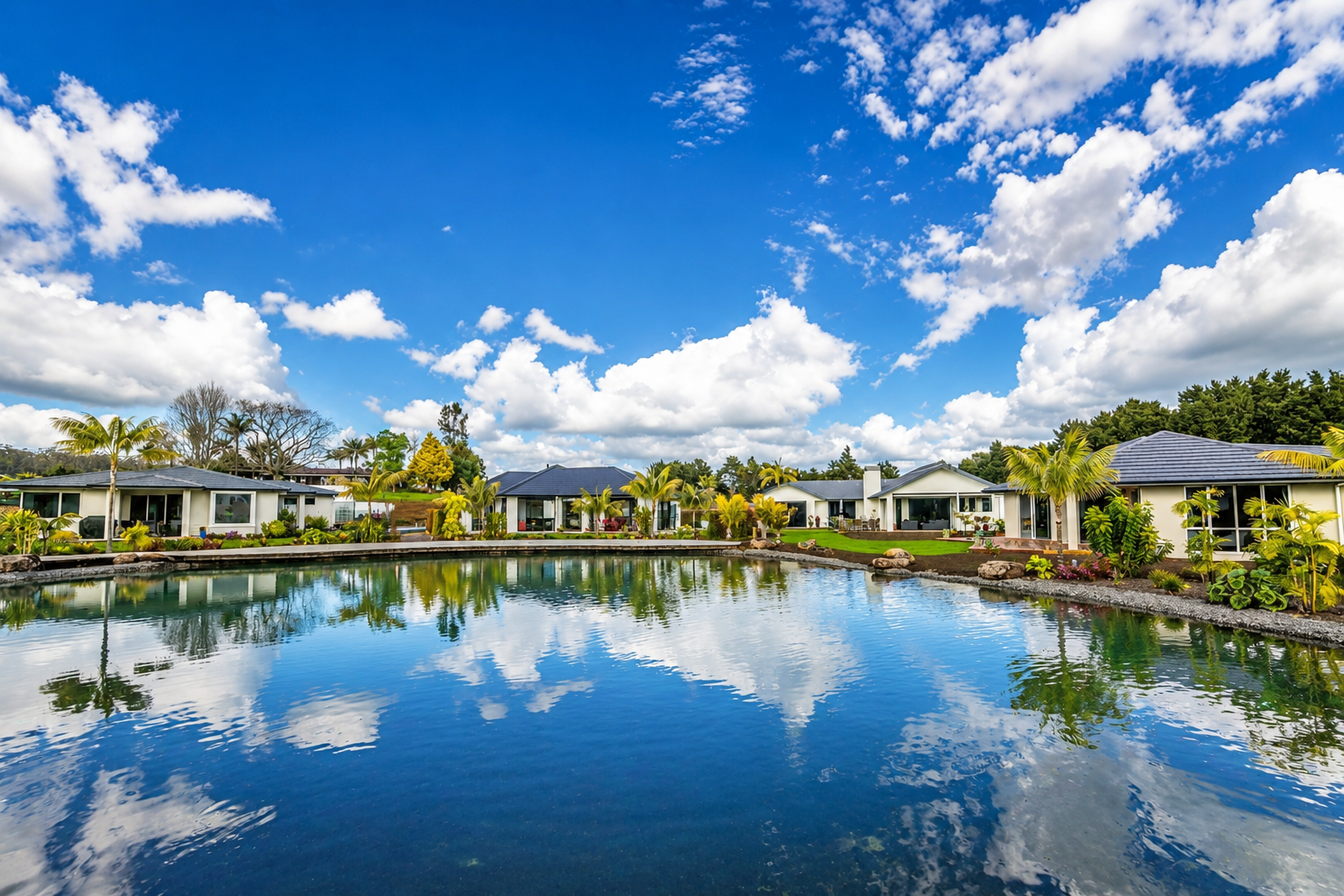
Design at Quail Ridge Country Club begins with place. Kerikeri sits within the Bay of Islands in a climate that is warmer and more settled than much of the country, and the architecture responds directly to that environment. Orientation, window placement, and outdoor flow are shaped by sun path, prevailing breeze, and the rhythm of subtropical seasons. These are not aesthetic gestures. They influence how comfortable a home feels in July as much as in January, and how often doors are opened to the garden rather than closed against weather.
Many residents arrive from Auckland, Hamilton, or elsewhere in Northland having lived for years in houses designed around density, traffic patterns, or colder conditions. Here, the relationship between interior and exterior shifts. Living areas are positioned to receive morning light and hold warmth through the afternoon. Patios extend directly from primary spaces, allowing meals, conversation, and reading to move outside without effort. The Bay of Islands landscape becomes part of everyday outlook rather than a destination reached after a drive.
Proportion matters in ways that reveal themselves gradually. A 2.7 metre stud height creates volume without exaggeration, giving rooms air and balance. Windows are sized to frame greenery and sky rather than neighbouring roofs. Hallways are broad enough to allow easy passage, and thresholds are level from garage to interior. Movement through the home feels intuitive because circulation has been resolved carefully. These qualities support present independence while also recognising that ease of movement becomes increasingly valuable over time.
Kitchens are configured for regular use. Bench space accommodates preparation without crowding, cabinetry provides storage that reflects real household needs, and appliances are positioned for efficiency. For residents who enjoy hosting family from Auckland or welcoming friends travelling north from Hamilton, the layout allows conversation to continue while meals are prepared. The dining and living zones connect naturally, and outdoor access extends the gathering space without rearrangement.
Garages are deliberately generous. Many residents continue to keep boats, golf equipment, bicycles, or tools associated with long held interests. Storage within the home supports retention of books, photographs, and furniture accumulated over decades. The design recognises that moving to Kerikeri does not mean abandoning identity. It allows continuity in practical terms.
Materials have been selected for resilience and longevity. Fully tiled bathrooms simplify maintenance. Flooring transitions are minimal, reducing trip hazards while maintaining aesthetic cohesion. Fixtures are chosen for durability. Climate control systems and insulation respond to Northland conditions, supporting comfort without constant adjustment. Ventilation pathways allow air to circulate, which is particularly relevant in coastal climates.
Landscape has been integrated with architecture from the outset. The village spans 42 acres of landscaped grounds with lakes, mature planting, and open space between homes.
Outlooks have been framed to capture greenery and water, reinforcing connection to the Bay of Islands environment. Paths link residences with shared facilities in a way that encourages walking as part of daily routine. For those accustomed to the pace of Auckland traffic or the colder winters of Hamilton, this relationship with landscape alters how days unfold.
Design also anticipates gradual change. Level entries, wide doorways, and accessible bathroom layouts provide flexibility without signalling adaptation. These elements sit naturally within the architectural language, supporting independence across years rather than responding reactively to need. Shared spaces such as Totara Lodge follow the same principle, offering light filled rooms connected to the surrounding grounds.
Kerikeri’s scale influences this design approach. The town provides services, cafés, and galleries within easy reach, yet retains a sense of openness. The architecture at Quail Ridge reflects that balance. It avoids excess while maintaining proportion. It supports active engagement with the Bay of Islands region while providing a stable base to return to each day.
Over time, the impact of these design decisions becomes evident in routine. Light enters at expected hours. Movement through rooms remains uncomplicated. Outdoor space is used frequently. Family visits are accommodated comfortably. Travel away from Northland happens without concern about upkeep because the structure of the village supports maintenance in your absence.
Designed for how you live in Kerikeri and the wider Bay of Islands, these homes provide continuity, architecture, light, flow, and landscape have been considered carefully so that daily life feels steady, practical, and connected to place, both now and in the years ahead.